

New week, new faith.
At each holy place, they are welcomed, and after each service they stay to chat with parishioners, explaining that, as Scientologists, they observe the precept laid down by L. Ron Hubbard to respect the religious beliefs of others. Part of demonstrating that respect is learning and understanding others’ beliefs—hence their attendance. The visits often conclude with a selfie taken with the pastor, rabbi, imam or other spiritual shepherd of the week.
“Anyone who regards religion as a marginal factor overlooks a part of the deep structure of our societies.”
My friends’ activities fit easily into a typical weekend, as there are a wealth of faith experiences just a short drive away.
America is, after all, the most religiously diverse major nation in the world, home to a rich array of beliefs and traditions.
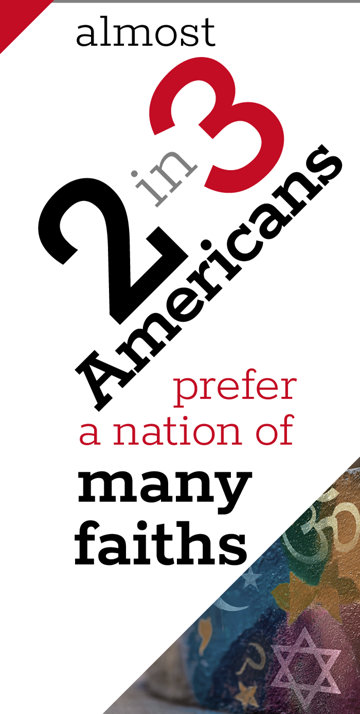
And according to a just-released poll, most of us like it that way.
The Public Religion Research Institute (PRRI) conducted an online survey in May among a representative sample of 5,469 adults ages 18 and up from all 50 states. It found that, 250 years into the American experiment, 64 percent of Americans prefer an America of many faiths. The door Miss Liberty opened to those seeking religious freedom remains wide open today.
In a world where nearly two-thirds of inhabitants suffer severe restrictions on religious freedom, where one-third of nations criminalize the practice of certain faiths, and where, for millions, worshipping according to one’s beliefs can be life-threatening, America’s commitment to religious liberty stands out as unique and enduring.
A comprehensive study by the Berlin-based Rockwool Foundation, drawing on centuries of historical and economic data, concluded that religion plays a far greater role in economic growth and prosperity than many people realize. Study lead author and economics professor at the University of Warwick in the United Kingdom Sascha Becker said, “Anyone who regards religion as a marginal factor overlooks a part of the deep structure of our societies. Religion still matters because it … still shapes the social norms and institutions through which policy operates.”
One area where religion’s influence is evident is education. Study authors noted that many schools in Europe are religiously affiliated. In England, for instance, a third of state schools have a faith affiliation—whether Roman Catholic, Jewish, Muslim or Anglican.
“Even quite secular parents may value faith schools because they associate them with a clear ethos, discipline, good behavior and aspiration,” Becker said.
As Mr. Hubbard observed, “Religion is the first sense of community. Your sense of community occurs by reason of mutual experience with others. Where the religious sense of community and with it real trust and integrity can be destroyed then that society is like a sand castle unable to defend itself against the inexorable sea.”
One doesn’t have to subscribe to a particular faith’s doctrine, then, in order to enjoy the benefits of its values and culture within one’s own community—as well as the wider sense of security, purpose and direction within one’s country.
This coming weekend, instead of binge-watching Netflix, why not follow the example of my friends and step inside a house of worship you’ve never visited before?
Who knows? You may just come away with a new understanding that, after 250 years, the experiment is over: Religious freedom works. Religious diversity works.
We can live side by side as many faiths, freely believing.
Now, smile for that selfie.