

And no wonder. This is America, a mosaic of different faiths, and now, according to a Pew Research Center study, the most religiously diverse among the world’s largest nations.
In its February 12 report, Pew ranked 201 countries and territories, and divided their populations into seven religious categories: Christians, Muslims, Hindus, Buddhists, Jews, adherents of other religions and those with no religious affiliation. Pew then measured the distribution of those categories in each country or territory. Each nation received a score between 0 and 10.
Religious diversity is no guarantee of religious freedom.
The United States, for example, is 64 percent Christian and 30 percent religiously unaffiliated. The rest—6 percent—consist of Muslims, Hindus, Buddhists, Jews and people in the “other religions” category. This earned the US a diversity score of 5.8, the highest among nations with populations exceeding 120 million. But when compared with all countries surveyed, 31 bested it.
Singapore placed first overall. Its religious tapestry comprises many faiths: 31 percent Buddhists, 20 percent religiously unaffiliated, 19 percent Christians, 16 percent Muslims, 5 percent Hindus and 9 percent in the “other religions” category. Its score of 9.3 dwarfs that of the runner-up, Suriname, at 7.5.
Among the takeaways from the study:
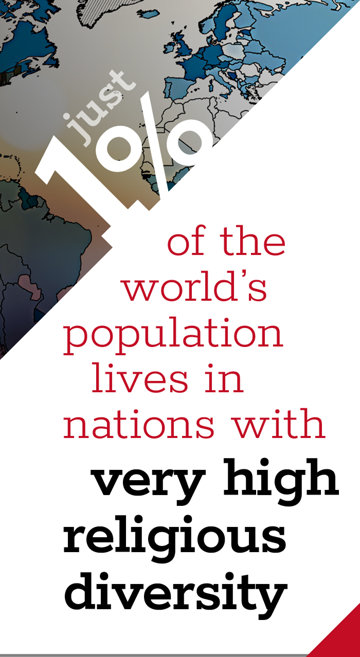
- Globally, just 1 percent of the world’s population lives in nations with very high religious diversity.
- In 194 countries and territories, at least 50 percent of the population belongs to a single religious group.
- Most countries saw their diversity scores change by less than 0.5 points between 2010 and 2020. A notable exception was the US, which rose from a “moderately diverse” 4.2 score to a “highly diverse” 5.8 in just one decade.
Perhaps the most crucial lesson, however, isn’t found in the statistics, percentages, or demographics, but beneath them—in the character and attitude of the nations themselves: Religious diversity is no guarantee of religious freedom.
Nigeria has a score that is identical to that of the US—albeit with a different set of faiths—yet is on the United States Commission on International Religious Freedom’s (USCIRF) list of 16 “Countries of Particular Concern” for “engaging in and tolerating systematic, ongoing and egregious violations of religious freedom.”
The government of Singapore, which topped the list, has banned several minority religions, including the Unification Church and Jehovah’s Witnesses, and has jailed multiple Jehovah’s Witnesses for declining military service on religious grounds. USCIRF notes that the government favors majority religions over minorities, undermining religious freedom.
Author and editor David Crumm emphasized the importance of Pew’s findings: “From the fury in American politics to the tragic patterns of global refugees and warfare—any hope for achieving peace rests on understanding our religious diversity.”
Our challenge is to apply that understanding, and to embrace and learn from our differences—to see diversity as an invitation to curiosity rather than contempt, respect rather than revulsion and dialogue rather than diatribe.
If America is indeed a mosaic of faiths, then the measure of its beauty and strength lies not in the sameness of its tiles but in the way they fit together to form something larger and more magnificent than any single piece alone.
And, ultimately, the measure of our strength as citizens of the world will not be how diverse we are on paper, but whether we allow that diversity to draw us together or drive us apart.