


Why?
How can you prescribe drugs for schizophrenia to patients who don’t have it?
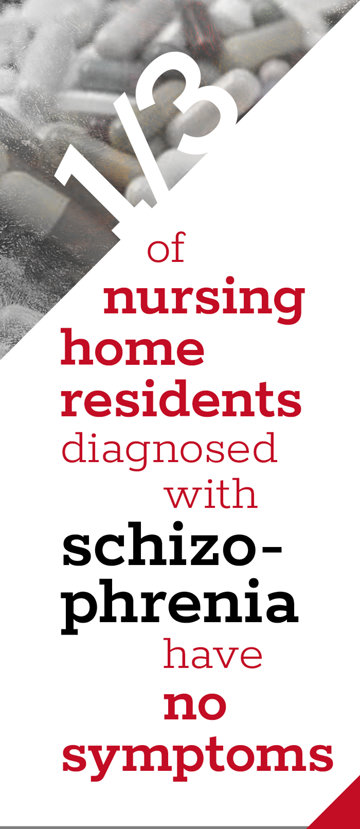
She wasn’t a danger to herself or others. Yet she was one of about 17 percent of long-stay nursing home residents prescribed antipsychotics. The diagnosis used to justify it—“schizophrenia”—is, according to two new reports from the US Department of Health and Human Services Office of Inspector General, applied without symptoms to one-third of patients.
Are elderly patients really a threat?
Or is something else going on?
Well, for one thing, antipsychotic drugs are a quick way to subdue a patient. In other words, it’s a labor-saving procedure for the nursing home personnel. There is a serious risk, however—for the patients, not the staff. Dementia patients on antipsychotic drugs can become drowsy and confused, unsteady on their feet and more prone to falls. They can suffer cardiovascular and cerebrovascular events, as well as permanent lung damage. And as FDA black box warnings make clear, antipsychotics can even cause death.
How do they get away with it? How can you prescribe drugs for schizophrenia to patients who don’t have it? Simple. Just diagnose everyone you’d like to drug with a “schizophrenia” label.
That should solve it.
The practice has the additional benefit (to the nursing homes) of artificially inflating their public performance scores. Medicare has a quality-of-care rating system for nursing homes. Your score suffers if your facility has patients falling or going to the ER, or if too many of your patients are frivolously prescribed antipsychotics.
If, however, you write “SCHIZOPHRENIC” on a patient’s record, that excludes that individual from the percentage (because, obviously, as a “schizophrenic,” he had to be prescribed the drug), which in turn prevents a high drugging rate that could damage the nursing home’s performance metrics.
One nursing home, for example, saw its reported percentage of residents prescribed antipsychotics drop from more than 80 percent to 5 percent in just a few years. This decrease corresponded with the facility systematically adding “schizophrenia” diagnoses to residents’ records, thereby masking the true rate of antipsychotic use while winning the nursing home a beautiful quality-of-care score.
Maybe it’s all a misunderstanding. No one would deliberately put elderly patients in harm’s way for ratings.
Or would they?
In a single day at one nursing home, a nurse practitioner added schizophrenia diagnoses to the records of dozens of residents after they were given antipsychotics, because he got a warning that the drugs were “triggering something.”
“We recognize it as a bad practice. It’s just what we all know: schizophrenia will fix the Quality Measures.” —A director of nursing
“The first approach is always medication.… Medication is fastest and easiest.” —Another director of nursing, explaining how non-drug approaches are more work, despite Medicare’s explicit requirement that nursing homes attempt non-drug interventions before prescribing antipsychotic drugs.
And the effects on our seniors in the twilight of their lives?
A 102-year-old woman was adjudicated “combative to care” and put on antipsychotics because she protested her briefs being changed. Yet a nurse who cared for her found that simply explaining what they were doing calmed her and made her more cooperative.
An elderly man sat in his own waste for hours because he was so drugged that he couldn’t press the call button to summon help.
Another resident didn’t like being sprayed by a shower nozzle during bathing. She preferred having the water poured over her with a cup. Instead of a cup, she was drugged for protesting the shower nozzle.
Another resident was prescribed a higher dosage of an antipsychotic because he developed pneumonia. After receiving proper treatment for the infection at a hospital, he returned in much better spirits—even singing. But the prescription—which had been increased to “treat” the pneumonia symptoms since cured—was never readjusted.
Then there was the nursing home resident who never made a fuss, was quiet, did not disrupt his living environment and stayed in his room. He was the model resident, yet was prescribed antipsychotics. No one at the nursing home could explain why.
As our population ages, we see the same message in our emails, on the internet, in our AARP newsletters: “Senior citizens, beware of scams!”
But what if the harm is coming not from outsiders, but from those within the very system entrusted with their care?
The nursing homes call it “fixing the Quality Measures.”
We call it elder abuse.