

The resolution did not arise from a fire alarm or medical emergency, but from a firefighter’s insistence that his faith be taken seriously at work—and by the government that employed him.
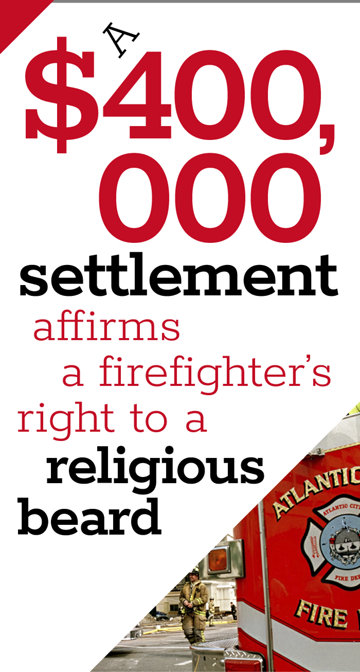
Alex Smith, an air mask technician with the Atlantic City Fire Department, has reached a $400,000 settlement with the city that secures his right to wear a short beard on duty as a religious accommodation. Smith, a devout Christian who also serves as a pastor and chaplain, challenged the department’s long-standing clean-shaven policy after his request for an exemption was denied. According to court filings, officials did not engage in dialogue or consider alternatives, despite Smith’s willingness to comply with reasonable safety measures.
“Americans of all faiths should be free to live out their convictions without fear in the workplace.”
The agreement’s significance extends well beyond Smith himself. It follows a May 2025 ruling by the US Court of Appeals for the Third Circuit affirming that public employers must accommodate religious practice under the Free Exercise Clause. The settlement also requires Atlantic City to revise its operational policies to comply with the US Supreme Court’s 2023 decision in Groff v. DeJoy, which strengthened workplace protections for religious exercise.
That ruling clarified the legal threshold for denying religious accommodations, with the Supreme Court holding that employers must grant such requests unless doing so would impose “substantial increased costs” on business operations—replacing a looser standard that had allowed agencies to reject accommodations with minimal justification.
Together, the appellate ruling and the Atlantic City settlement reset how fire departments and other public agencies across the country must evaluate claims of religious conscience, particularly in highly regulated public safety roles.
Smith’s role within the Atlantic City Fire Department is technical and directly tied to firefighter safety, largely behind the scenes. As an air mask technician, he fits breathing masks for firefighters and refills air tanks used during active fire suppression—equipment that must function flawlessly when smoke and heat overwhelm enclosed spaces and oxygen thins.
Department leaders cited a general fire service grooming policy, arguing that facial hair can interfere with mask seals worn by firefighters—a concern Smith said did not apply to his role and was never assessed on an individual basis.
When Smith requested a religious accommodation, the department denied the request.
At the heart of Smith’s claim is a religious conviction rooted in his reading of scripture and Christian tradition. Some Christians interpret passages such as Leviticus 19:27—which cautions against trimming the edges of the beard—as a continuing moral guide, while also noting that Jesus and the Apostles, shaped by first-century Jewish custom, would almost certainly have worn beards. For Smith, maintaining a beard was not aesthetic preference but an expression of conscience tied to pastoral identity and faith practice.
In May 2025, the Third Circuit agreed that Smith’s beliefs were entitled to constitutional and statutory protections. The court rejected the notion that religious liberty is a subordinate right in the workplace, holding that the fire department had failed to adequately meet its obligation to consider accommodation. The ruling further emphasized that public employers must do more than cite generalized concerns when denying religious requests.
That appellate victory set the stage for the settlement finalized this month. Under its terms, Atlantic City will pay $400,000 to Smith and his attorneys and will continue his salary and benefits while he remains on authorized leave until his retirement. The settlement will also formally revise fire department operational guidelines to reflect current Supreme Court precedent. The city agreed as well to implement annual religious diversity training for department leadership, incorporating Equal Employment Opportunity Commission guidance on religious discrimination.
Legal advocates involved in Smith’s case underscored the broader implications of the outcome. “This victory for Alex reflects the important precedent he set for all first responders at the Court of Appeals for the Third Circuit,” said Kayla Toney, counsel at First Liberty Institute, which, along with the Harvard Law School Religious Freedom Clinic and Beldock Levine & Hoffman LLP, represented Smith in his litigation. The agreement, Toney added, “secures our client’s religious liberty and financial future.”
Harvard Law School Assistant Clinical Professor Joshua McDaniel, who also serves as faculty director of the university’s Religious Freedom Clinic, framed the settlement as a reinforcement of pluralism in public life. “Americans of all faiths should be free to live out their convictions without fear in the workplace,” he said, noting that the precedent significantly strengthens employees’ ability to do so.
For Luna Droubi, a partner at Beldock Levine & Hoffman LLP, the case illustrated a recurring workplace tension. “No one should be forced to choose between their faith and their livelihood,” she said, describing the settlement as a reminder that the Constitution protects conscience even within hierarchical, safety-driven professions.
Though Smith’s case has concluded, advocates caution that religious accommodation disputes remain widespread. First Liberty Institute reports ongoing litigation involving healthcare workers, airline employees and educators who allege discipline or termination after seeking faith-based accommodations. Those cases, attorneys say, will further test how rigorously employers apply the Groff standard in practice.
By contrast, the Atlantic City agreement now stands as a practical blueprint. It demonstrates how public agencies can reconcile operational demands with constitutional obligations through individualized assessment, policy revision and education, rather than automatic denial. For fire departments and other emergency services navigating similar requests, the lesson is procedural as much as philosophical.
As Smith looks toward retirement with his rights affirmed, the broader impact of his stand continues to unfold. In firehouses far from the Boardwalk, administrators are reassessing grooming rules, accommodation protocols and training curricula in light of a settlement that has quietly reshaped the balance between uniformity and liberty.
In that recalibration lies a forward-looking reminder that constitutional protections do not recede at the station door. They accompany those who serve, even into the most regulated corners of public life.