

A physician from Boston recalled his burning desire to write a story about freeing a dragon from the Bronx Zoo. A Missouri author reflected on an unlikely friendship between a spirited cheese-loving dragon and a mild-mannered baker. And a Norwegian astronaut saluted science fiction writers and illustrators for helping humanity build the fiery Dragon spacecraft that carried her on last year’s first-ever crewed SpaceX polar flight.
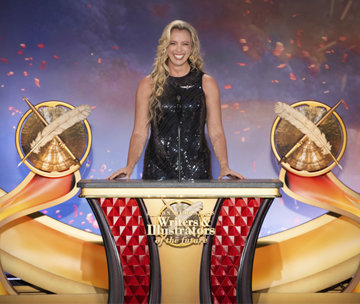
“To all writers and illustrators who are here with us tonight, I want to thank you and I want to thank the creators who came before you, because my crew and I would not have gone into space in the Dragon if it were not for the science fiction writers that dreamt up the possibilities that we made fact,” said Jannicke Mikkelsen, the first fully Norwegian astronaut and keynote speaker at the April 16 black-tie gala in Hollywood.
“The future you imagine is a future we will all one day explore.”
“It is an absolute honor to be here, and especially at the moment when man is again reaching the moon and beyond,” Mikkelsen said, referring to the recent Artemis II moonshot, the first crewed flight into lunar space in more than half a century. “The future you imagine is a future we will all one day explore,” she added, praising the science fiction community for its “creativity, grit and pursuit to broaden humanity’s perspective” through storytelling and visual art.
The occasion marked the 42nd Annual Writers of the Future Awards and the 37th Annual Illustrators of the Future Awards, held at the Taglyan Complex, steps from the Hollywood Walk of Fame. The event was organized by Author Services, Inc., the literary agency that develops and publishes the fiction of bestselling author L. Ron Hubbard.
Mr. Hubbard launched the Writers of the Future Contest in 1983 as a platform for emerging authors of speculative fiction—those who work “continually to give tomorrow a new form,” he wrote. Five years later, a companion competition for visual artists opened the same door to illustrators.
The contest unfolds over four quarters each year, with a panel of distinguished judges selecting three quarterly winners in each category. Their work is then collected in the annual anthology L. Ron Hubbard Presents Writers of the Future, whose 42nd volume was released at the gala this year.
Over the decades, the Writers of the Future Contest has launched 583 winners and published finalists who have gone on to produce more than 8,000 novels and short stories. Its companion Illustrators contest has recognized 430 winners whose work spans more than 6,800 illustrations and 390 comic books, with credits across books, films, television and games.
That legacy is carried forward in this year’s anthology. Its cover features “The Fire Tribe,” a painting by acclaimed fantasy artist Ciruelo Cabral, whose work has appeared with some of the most prestigious publishing houses in Europe and the US. Rich in mythic atmosphere, danger and beauty, the image depicts two female warriors and a mighty dragon defending an island dominated by an erupting volcano.
This year’s theme—Fantasy, Alternate History and Imagination—drew from both the anthology and the spirit of the contest. John Goodwin, president of Galaxy Press, which publishes and markets Mr. Hubbard’s fiction, said the cover painting supplied the “fantasy” element, an accompanying story by Orson Scott Card offered an “alternate history” of alien life on Earth, and “imagination” was the common thread running through the work of winners and judges alike.
Before the gala, that same spirit was evident in one of the contest’s most memorable traditions: the Art Reveal. There, writers and illustrators discover how their stories and illustrations, assigned months earlier, come together for the first time. Each participant also earns a place in a weeklong workshop guided by established figures in the Writers of the Future community, including Card, whose story “Skinny-Shins” appears in Volume 42 and was inspired by Cabral’s cover painting.
This year, as always, the contest’s journey culminated at the gala. In a vast chandelier-lit ballroom, sometimes described as the “restaurant at the end of the universe,” writers and illustrators from the US and around the world, including Australia, Canada, South Africa, Slovakia and Britain, sat down to dinner as years of private effort gave way to public recognition. Then came the evening’s highest honors: the Golden Pen and Golden Brush, awarded to the year’s standout writer and illustrator, each with a $5,000 prize and a significant leap into the professional ranks.
“If the writers and illustrators who create these ideas weren’t reaching the rest of the world, then it would be a much duller place.”
The 2026 Golden Pen went to Michael Kuester for “In Living Color,” the story of a man with the paranormal ability to step into pictures and connect with the emotions of those within them. Kuester used his acceptance remarks to salute the city that shaped him. “It takes a village to write a story, and I have a whole city to thank,” he said. “Cincinnati,” he added, invoking both his hometown and the setting of his story, “is a place where ordinary people do extraordinary things every single day.”
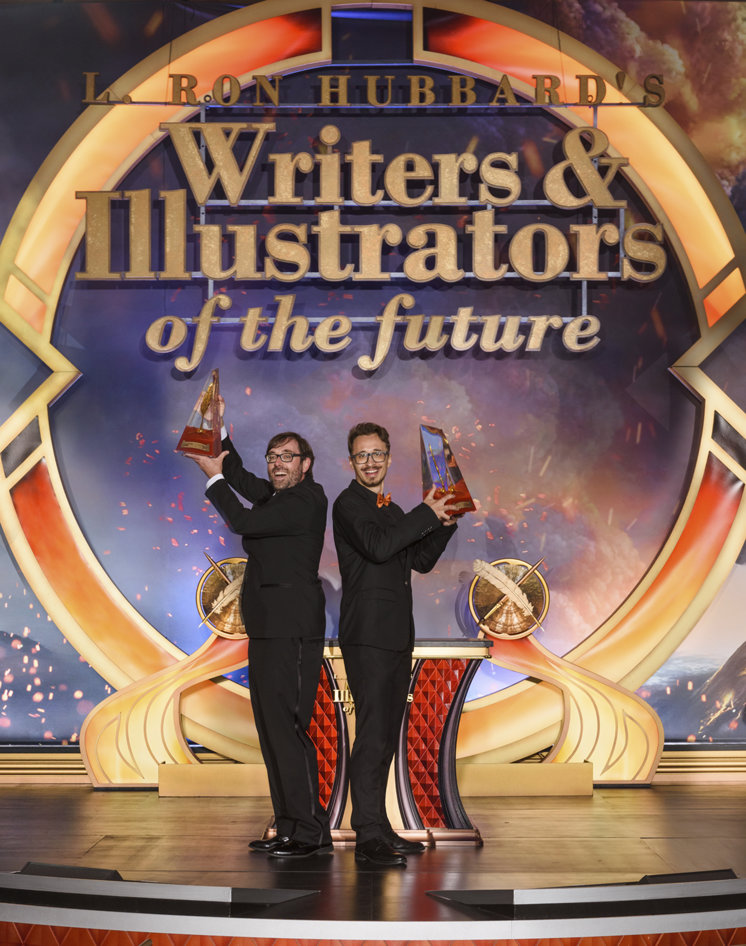
The Golden Brush was awarded to Slovakian artist Bafu, whose illustration brought to life Kathleen Powell’s “Saffron and Marigolds,” a story about the ravenous turophile dragon mentioned earlier and the baker who befriends it. Powell had submitted to the contest 22 times before finally breaking through.
She said the spark for her story came after reading “Circulate,” an essay by L. Ron Hubbard published in Volume 39 of the anthology series, in which Mr. Hubbard wrote: “And in despair, we wail that there is nothing of interest in our surroundings or in the lives we lead. We say that and we believe it.… Someone else comes around, looks us over and studies our environment for a brief period and then goes off to write a novel. Why, we moan, didn’t we write that book?”
Powell said the passage prompted her to see that the raw material for fiction already existed in the world around her. Instead of asking why someone else would write that story, she decided to ask herself a different question: “Well, why not?”
Reflecting on what she would say to science fiction creators discouraged by rejection, Powell told Freedom she was “sure all the great writers have had hundreds and hundreds of rejections.” She said her presence at the gala felt like the payoff for years of persistence, adding: “I think you just have to love it, and you have to know that this is what you want to do, even if you never get the prestige or the acclaim.”
That spirit of perseverance and possibility is one reason veteran science fiction author Jody Lynn Nye, the contest’s coordinating judge, described the genre as the “literature of hope.” In a moment of deep uncertainty, she said that outlook matters more than ever. “People feel very uncertain [and are] concerned that the structure they have seen in past years may be crumbling or getting chipped away,” she told Freedom. “And science fiction gives them potential visions—something that they can think of and say, ‘someday this could happen.’”
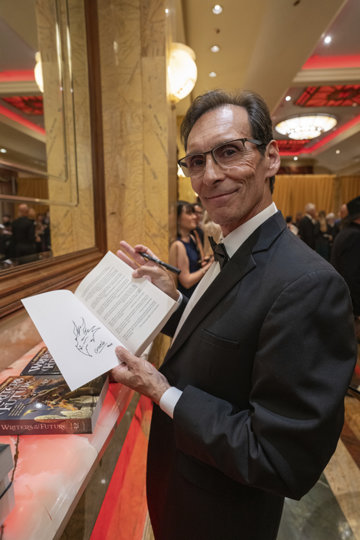
A similar sense of imaginative propulsion has long been felt by those working at the edge of real exploration. “Futuristic stories and ways of getting to other planets are a palette of ideas for engineers and scientists to think about and see if they can make them happen,” said Robert Hogg, an engineer at NASA’s Jet Propulsion Laboratory in Pasadena, who was among the gala’s distinguished guests. That, he told Freedom, is precisely why the people who create such visions deserve to be celebrated.
“If the writers and illustrators who create these ideas weren’t reaching the rest of the world, then it would be a much duller place,” Hogg said. “And frankly, our civilizations and humanity in general wouldn’t evolve and become better.”
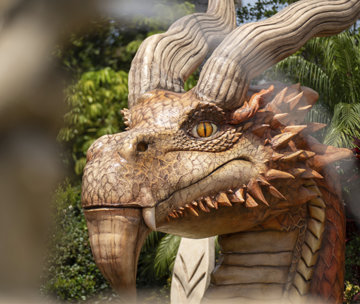
On a night where dragons stood for the imaginative worlds celebrated throughout the gala, the most important point is that science fiction and fantasy do not merely entertain—they enlarge the field of the possible. And every year at Writers and Illustrators of the Future, a new generation is invited to do exactly that.