

The practice is known as mechanical restraint and carries well-documented risks: pressure injuries, asphyxiation, musculoskeletal harm and even death.
Nearly a decade after the 2016 incident, the European Court of Human Rights (ECHR) has ruled unanimously that Denmark violated Article 3 of the European Convention on Human Rights, which prohibits torture or inhuman or degrading treatment. The ECHR ordered the state to pay the victim €20,000 in compensation.
Up to 48 hours of binding a human being to a bed with straps and cuffs does not, by definition, cross into the inhuman—until the clock runs out.
The ECHR found that approximately 11.5 of the 13 days of being strapped down exceeded what was strictly necessary.
By the way—what is “strictly necessary”?
According to Denmark’s Psychiatric Patients’ Complaints Board: 48 hours.
That is, up to 48 hours of binding a human being to a bed with straps and cuffs does not, by definition, cross into the inhuman—until the clock runs out.
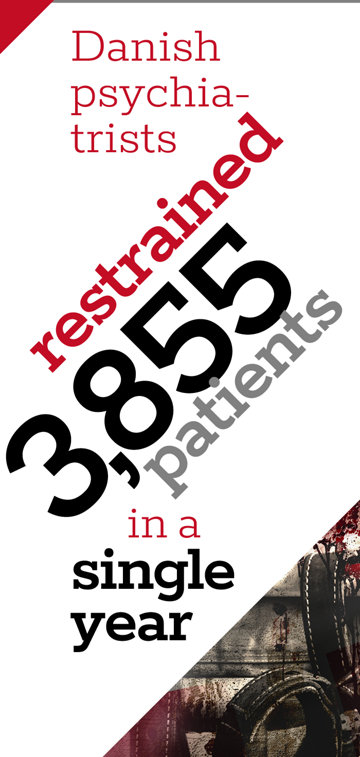
In 2024 alone, Danish psychiatrists strapped and restrained 3,855 patients, for an average of 17 hours each, well within the “strictly necessary” range.
As it happens, both Denmark’s 17-hour average and the Complaints Board’s 48-hour limit far exceed the four-hour threshold at which the risk of life-threatening blood clots and pulmonary embolism rises. Other risks from the practice—quite aside from the emotional trauma—include suffocation, injury and death.
But not to worry. According to the Complaints Board, any suffocation, thrombosis or death occurring prior to the 48-hour mark is still kind and humane.
Shakespeare said it best: “Something is rotten in the state of Denmark.”
But Denmark isn’t the exception. It’s the rule.
When a system defines two days of restraint as “necessary,” it is no longer treatment—it’s control. Like a mean-spirited child smashing a toy it can’t fix, psychiatry vents its frustrations and failures on the patients it claims to help.
Witness this:
Over 80 percent of America’s psychiatric institutions for children and adolescents use restraints or solitary confinement to control their patients.
Forty-five percent of psychiatric inpatients report being victims of sexual violence while held in institutions.
Settlements as high as $400 million for assaults, torture, rape and death have become routine costs of doing business for America’s “mental health” institutions.
Children as young as 5 receive electroshock in America—a procedure in which 460 volts of electricity are sent through the brain—an experience survivors describe as a grenade exploding in one’s head.
Since 1965, 1.1 million people have died in psychiatric hospitals, more than twice as many as the soldiers killed in all of America’s wars since 1775.
Was it all “strictly necessary”?